This is the moment in the year when we pause and reflect on how we evolved.
How the platform has grown, and what has meaningfully improved for the teams relying on it every day.
In 2025, we did not simply add new features. We moved beyond incremental progress and began redefining what WordPress hosting can be.
The direction was clear: greater composure under load, more precise performance controls, and safer operations without added complexity.
That theme runs through every change that follows.
It begins at the most fundamental level: the network architecture that powers every request.
Pressidium EDGE: A New Foundation
Performance, security, and resilience were already strong in our former advanced architecture. What changed were traffic patterns. Threat mitigation had to move earlier in the request path, and global speed was no longer a differentiator but an expectation.
Pressidium EDGE was introduced to meet that reality. It is a globally distributed network layer designed to operate intelligently at the edge, closer to end-users worldwide.
Most importantly, it is an integral part of our architecture.
Faster Performance Everywhere
Edge moves request handling closer to users worldwide. Both static assets and dynamic pages can be cached and served directly from edge locations, reducing response latency.
The result is faster Time to First Byte, improved Core Web Vitals, and more consistent performance regardless of visitor location.
Caching is precise, not blunt. Rules can be defined by URL patterns, cookies, geography, device type, or user state. Logged-in users can bypass caching, while public content benefits from global edge delivery.
Moreover, modern protocols like HTTP/3 further improve connection setup and responsiveness, especially on mobile and high-latency networks.
Security That Stops Threats Earlier
Edge absorbs malicious requests before they reach the WordPress application layer.
Brute force attempts, DDoS traffic across multiple layers, and WordPress-specific exploits are blocked at the edge.
The Edge WAF includes network-level protection, application-level rules, and WordPress-aware mitigation that scales globally without performance penalties.
Built-In Resilience at the Platform Layer
Pressidium EDGE also changed how resilience is handled. Serving more requests at the edge locations during traffic spikes reduces pressure on origin infrastructure.

This stabilizes performance during high-demand events without manual intervention.
In the event of a regional incident, traffic handling is managed without any DNS changes. Once the affected origin site is restored, Edge automatically and transparently resumes delivery, with no impact on end users.
Pressidium EDGE operates as part of the platform, not beside it.
Not an add-on service. Not a plugin. It is the gatekeeper of the Pressidium experience.
Operational Workflow: Dashboard Consolidation
Daily operations are where platforms either help or get in the way.
In 2025, Dashboard work centered on consolidation. Fewer places to check, fewer repetitive actions, and clearer visibility across large site portfolios without pushing teams into new workflows.
A Smarter Dashboard Home
The new Account Home page became a true starting point for the day. This redesigned view brings everything that matters into one clear, intuitive layout.
Active websites, traffic signals, support status, team structure, plan details, and platform updates are all visible at a glance. There is no need to dig through menus to understand account health or next steps.
The Websites section quickly surfaces the most visited sites and provides direct access to management actions.
Support visibility is intentionally lightweight. If there are no open tickets, the dashboard confirms that clearly. If action is needed, it is one click away.
Team management and billing information are equally transparent, while fresh content from our blog is integrated without interrupting workflow.
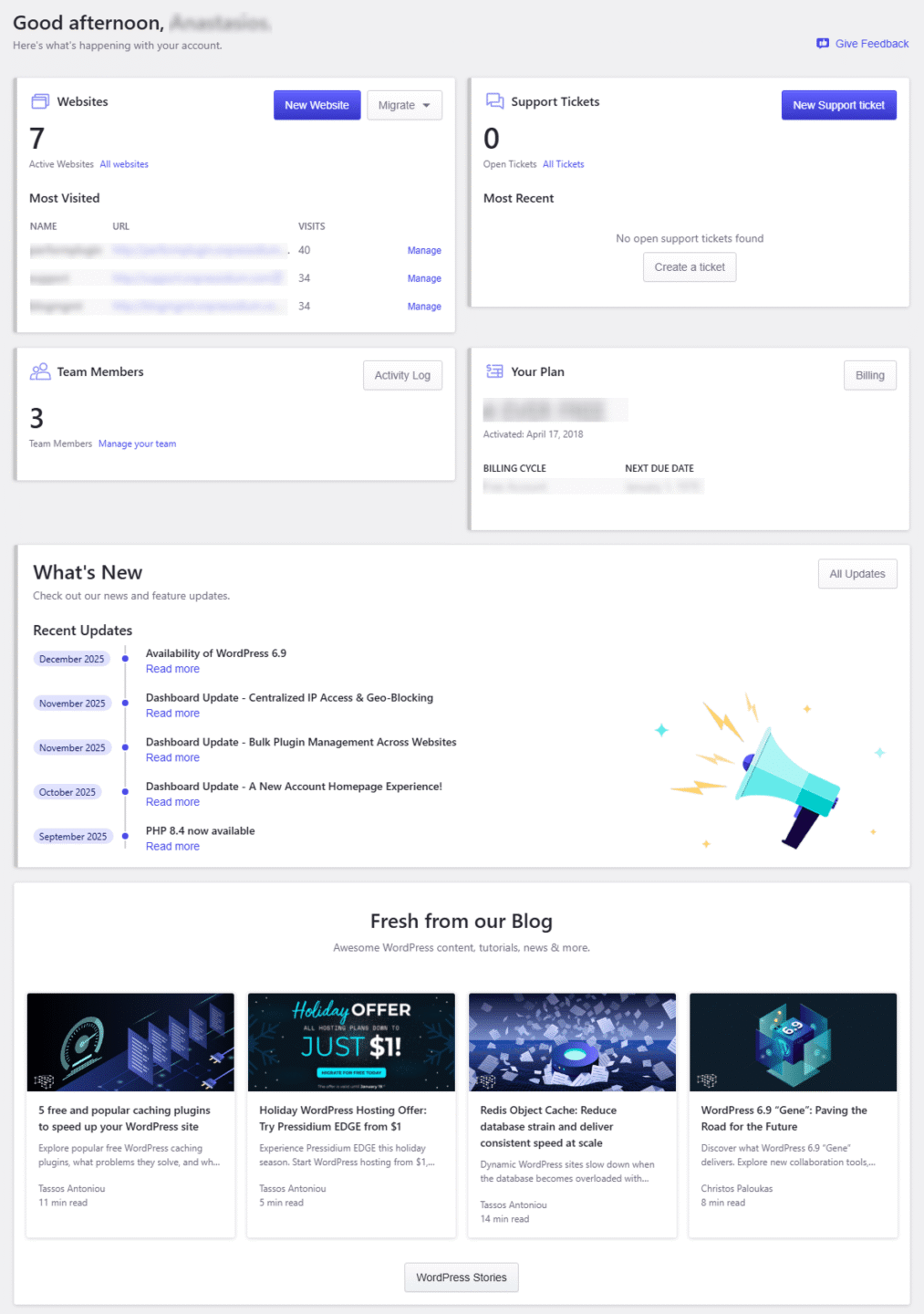
The result is a dashboard home that behaves less like an admin panel and more like a control surface. It reduces friction, restores context, and reflects how modern WordPress infrastructure is actually managed.
Additional Download Options for Access Logs
Access log handling was also improved this year. A new dashboard feature helps teams gain control over the structure of exported access logs.
When downloading access logs, they can now choose between Common Log Format (CLF), Combined, or custom property sets, exporting only the fields that matter for the task at hand.
These new log download options give teams flexibility over what data they export and how it is formatted. The ability to select only the properties you need makes troubleshooting faster, keeps files lean, and reduces unnecessary data exposure.
Geo-blocking and Centralized WAF control
Security work focused on reducing the situations that demand urgent response in the first place. The goal was fewer urgent tickets and late-night interventions.
Geo-blocking was introduced early in the year to give teams direct control over where traffic is allowed to come from. It made country-level restrictions straightforward, whether for compliance reasons or to reduce exposure to unnecessary risk.
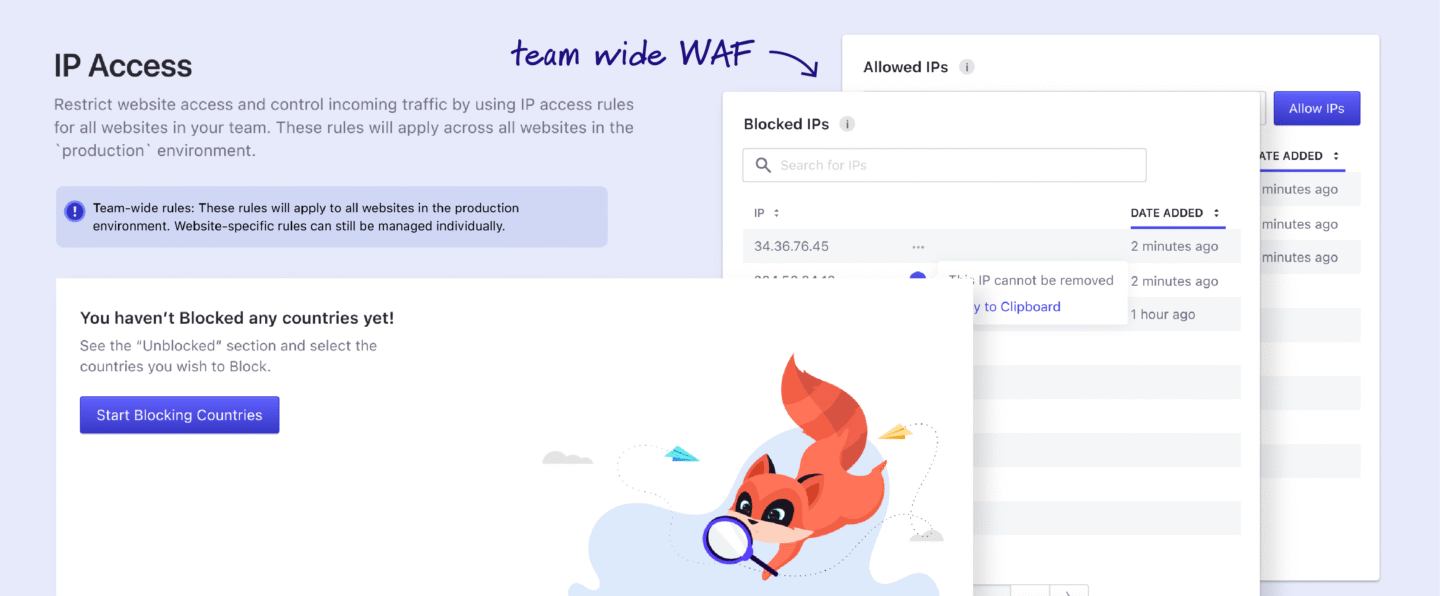
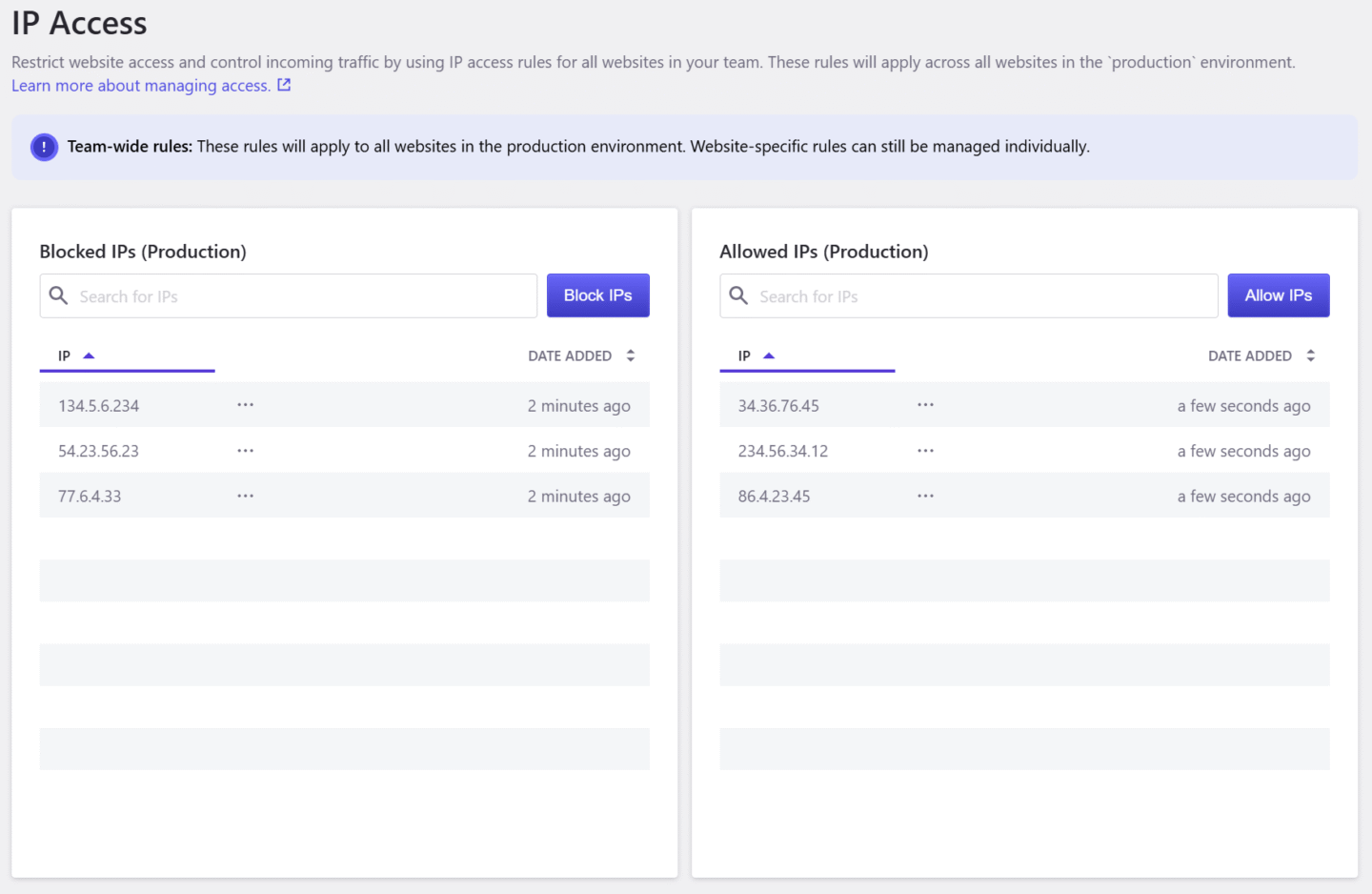
IP allow and block rules, along with Geo-blocking, can now be defined once and applied across all sites in a team. Security policy moved up a level, reducing duplication while still allowing site-specific exceptions when needed. That means fewer configuration gaps and less manual overhead.
Better Plugin Management
Managing plugins across multiple sites is a well known daily challenge for teams.
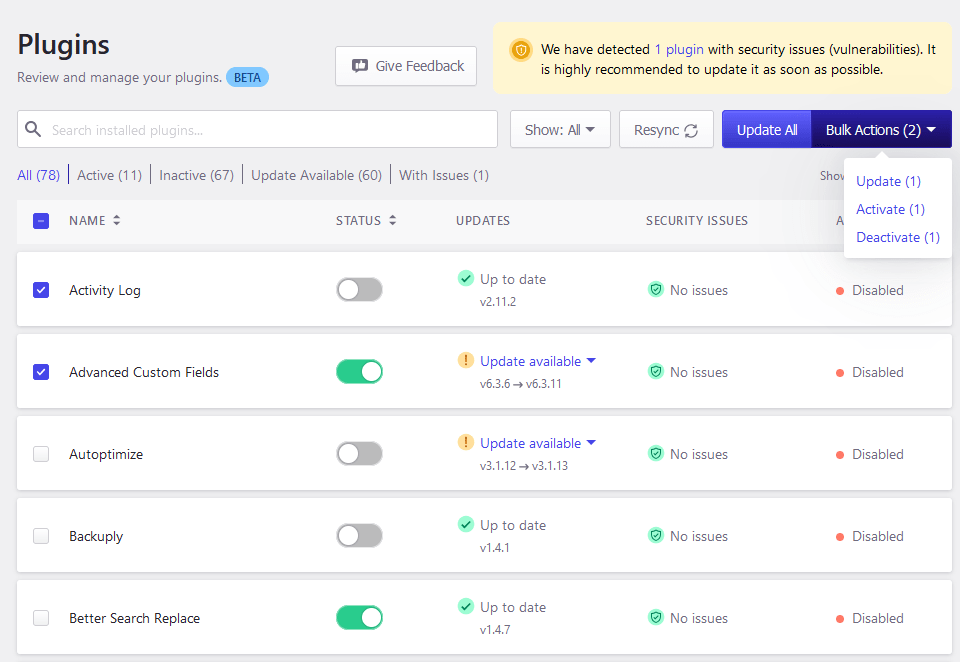
In January, we introduced a dedicated Plugin Management screen in the Pressidium dashboard that brought bulk actions into one place.
Plugins can now be updated, activated, or deactivated across sites without hopping between admin panels.
Instead of treating sites as isolated units, teams gained a portfolio-level view of plugins across all websites. Therefore, updates, vulnerabilities, and version drift became easier to spot and easier to act on.
Partner Ecosystem Growth
As the platform evolved during the year, attention naturally shifted outward as well.
We formalized our approach to partnerships with the launch of the Pressidium Certified Partner Network. The goal was to support agencies and specialists who build, manage, and scale demanding WordPress sites as a core part of their work.
The network was designed to create clarity around who our partners are, what certification represents, and how those partners are positioned within the ecosystem.
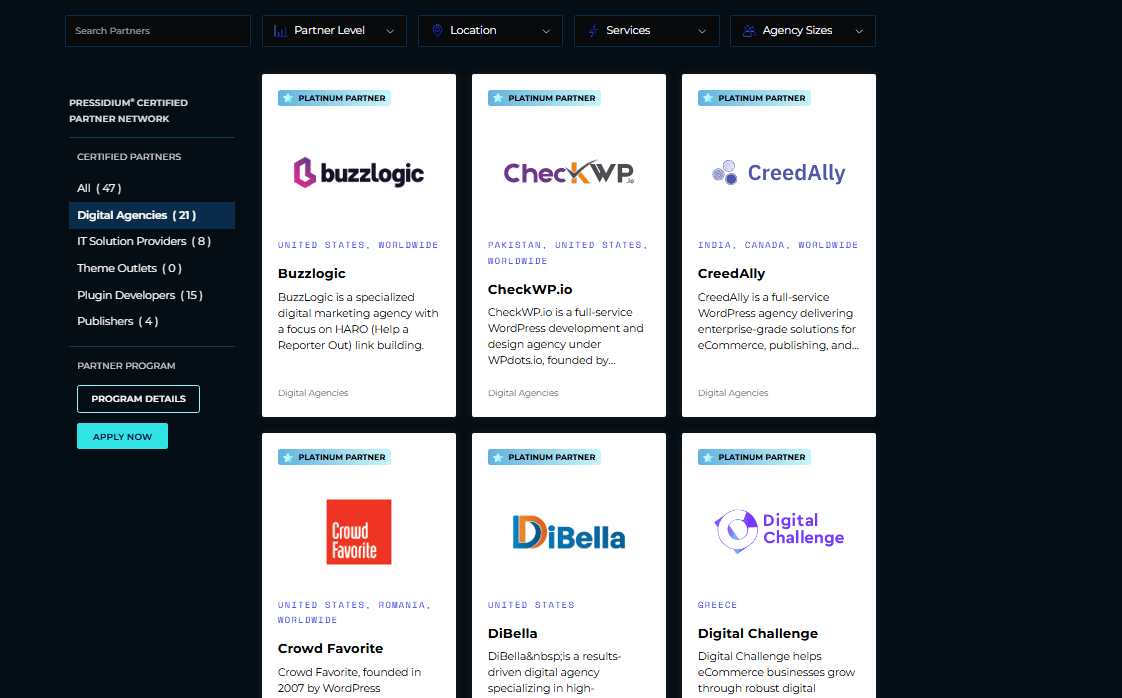
The program introduced lifetime recurring commissions and practical partner benefits. More importantly, it established a clearer path for partners to grow alongside the platform, with direct access to our teams and an ecosystem built on trust rather than volume.
Partners are discoverable by expertise, focus, and geography, but more importantly, every listing is intentional. Each partner is vetted. Each one exists for a reason.
Strong platforms do not operate in isolation.
They grow through the teams that use them every day.
The Pressidium Performance Plugin
Client-size optimization is an ongoing responsibility, and a quick and practical solution is a common need among site owners and admins.

The Pressidium Performance Plugin focuses on a well-defined scope: image optimization, asset minification, and transparent background processing.
Each feature is intentional. Nothing overlaps.
It is also important to note that all processing runs in the background, so that sites remain responsive while optimizations take place.
The Performance Plugin was built by the performance fanatics at Pressidium.
It is not positioned as a full release yet; however, it is available for teams who want to download it and test it before it becomes part of the broader platform story.
Operational Continuity and Platform Stewardship
Introducing new capabilities is great, but without a well-maintained operational foundation, they do not earn trust.
WordPress Core, Steady by Design
Keeping WordPress core up to date is rarely about the update itself.
What matters is maintaining control without creating pressure or disruption.
Throughout 2025, the workflow did not change, and that was the point:
✔️ Core stayed current, but never rushed.
✔️ Updates stayed available, but never disruptive.
During these updates, teams stayed informed and in control of when and how changes were applied.
Runtime Upgrades Without Disruption
Runtime upgrades were also handled deliberately. The goal was to raise the performance and security baseline without adding operational pressure.
PHP version switching remained fully self-serve through the Dashboard. Teams could move between PHP versions when it suited their release cycle, using staging environments, site clones, and instant rollback options to validate changes safely.
We encouraged teams to adopt newer PHP versions by clearly communicating end-of-life timelines and the benefits of modern runtimes, while keeping upgrades reversible and fully under their control.
The result was quieter operations that stayed current without becoming a source of risk.
Customer Feedback and Real-World Impact in 2025
One thing came through clearly in customer feedback this year: hosting was no longer a daily concern.

At DiBella, an agency managing more than 100 WordPress sites, the biggest change was operational. Migrations were smooth, performance stabilized, and time previously spent troubleshooting hosting issues shifted back to client work. With a dependable platform underneath, scaling became easier and more predictable.

For Studio 3T, performance improvements were immediate. Page loads became faster, response times dropped, and the site felt consistently responsive for users around the world. Just as importantly, infrastructure stopped demanding attention.
Hosting simply did its job.

For Counselling Tutor, stability made the difference. Their high-traffic learning platform became faster and more responsive for both learners and administrators. Tasks that once felt slow or disruptive faded into the background, creating space to focus on content, students, and community growth.
Across all three cases, the takeaways converged on the same points:
✔️ Performance improvements were noticeable and immediate
✔️ Operational overhead dropped sharply
✔️ Support interactions felt collaborative and solution-driven
✔️ Hosting faded into the background, where it belongs
Feedback consistently reflected a platform that was dependable under real-world conditions. This is what customers valued most.
Giving Back to the WordPress Community
As part of our ongoing work, we continued our commitment to the WordPress project through the Five for the Future initiative. This participation represents real time dedicated to keeping WordPress stable, accessible, and moving forward responsibly.
Our Pressidium Cookie Consent plugin also remained actively maintained throughout the year and was used by more than 10K sites. To support correct implementation, we also published a Google Tag Manager consent template, helping teams apply consent mode consistently without guesswork.
One more highlight this year was our direct involvement in WordCamp Europe 2025, which took place in Basel. Our Product Designer, Ioanna Aravani, was part of the Design Team, helping shape the visual identity and attendee experience of the event.
We also stayed active in local WordPress communities. In February, our Performance Engineer, Christos Paloukas, spoke at an Athens WordPress Meetup organized by the WordPress Greek Community, sharing a practical deep dive into caching layers in WordPress. These conversations help keep platform decisions grounded in real-world usage and everyday performance challenges.
WordPress continues to grow because people invest their time and expertise into it. Supporting that work remains a responsibility we take seriously.
Looking Ahead
This year, Pressidium not only focused on expansion, but on alignment with how the web actually behaves today, and where it is clearly heading next.
Pressidium EDGE is now delivered as an integrated part of Pressidium Hosting, and its impact is already clear. Customers have experienced faster delivery, stronger protection, and greater resilience without changing how they build or run WordPress.
The next step is already within reach. We are very close to making Edge available as a standalone service. This will allow site owners to keep their existing hosting provider while enjoying the Edge benefits. And this expands access to Edge without replacing or altering the existing Pressidium Hosting experience. Both offerings will continue to evolve in parallel.
At the same time, work on the Pressidium Performance Plugin is moving quickly, and feedback from early testers has been strong. The focus remains on validating behavior across diverse environments and ensuring that client-side optimization stays transparent, disciplined, and clearly bounded. We look forward to sharing its first release.
Taken together, these steps reflect a broader shift in how we approach the future of WordPress infrastructure. That is not a departure from the direction set in 2025.
It is the natural next step.
The clearest way to understand this approach is to experience it directly.
Start your free Pressidium trial today and leave outdated systems behind.
Run a real site on our platform and let Pressidium EDGE carry the weight.
What you notice, and what you do not, will tell you everything.
Start Your 14 Day Free Trial
Try our award winning WordPress Hosting!