You did everything right, yet it still isn’t enough
If you’re running a WooCommerce high-traffic site “the right way” and it still feels fragile, you’re not imagining it. That’s actually where many teams find themselves today.
A demanding WooCommerce eshop is usually supported by a sensible, industry-recommended stack: caching plugins, a CDN, external firewall protection, monitoring, backups, and hosting tuned for WordPress.
This is broadly considered best practice today. And for a while, it works.
But as the site grows and traffic increases, this model slowly turns into a system that requires constant coordination across these layers and becomes increasingly fragile under peak demand, where small misalignments can have outsized impact.
Meanwhile, your higher revenue means lower tolerance for downtime.
This is the paradox at the heart of modern WooCommerce operations: the more effort invested in “doing it right,” the more fragile the system feels under pressure. Your store grows, but confidence doesn’t grow with it. A campaign spike is no longer exciting. It is a stress test.
You did nothing wrong.
This pattern is a sign that the stack model itself is being stretched beyond what it was designed to handle.
What “doing it right” actually looks like
Let’s take a close up to how the current solution applies.
A CDN probably sits in front of your site to reduce latency and serve assets closer to users globally. A performance plugin handles caching and front-end optimization, while an external WAF for extra protection is active. The stack looks responsible and correct.
Under normal traffic, this separation of responsibility goes largely unnoticed because the system is rarely pushed to its limits. However, as your site evolves, traffic becomes more demanding and requests become more complex.

You need to handle logged-in users differently and adjust rules to avoid caching carts and checkout. Certain cookies are bypassed, edge rules are added to prevent breakage, and security policies evolve to accommodate legitimate traffic without blocking real customers.
While this looks like maturity on paper, in practice, the system functions only because it’s being constantly negotiated across separate layers.
The underlying risk
Under pressure, these independent configurations may not align properly and trigger issues: checkout may not work for some users, or carts may fail to update at the worst moment.
Picture this: it’s Black Friday and traffic is 5x higher than normal. A customer adds a product to their cart, the cart refreshes, and they move to checkout.
Behind the scenes, the layers responsible for performance and protection are operating independently.

The caching plugin may serve a slightly stale cart because it fails to detect the session cookie in time. At the same moment, the firewall sees the sudden spike in traffic and applies additional checks that introduce latency. Meanwhile, the CDN delivers a cached HTML response that wasn’t configured with full awareness of WooCommerce session logic.
What the customer sees is a cart that does not update and a payment that times out.
They refresh, then they try again, and leave the site.
In the end, the unsettling irony is that you lost a sale, while all your tools technically operated correctly.
The growing cost of patching the problem
At this stage, the instinct is to look for adjustments. More cache exclusions, cookie checks, bypassed conditions, allow lists, rate limits with exceptions.
But every new rule expands the number of possible ways a request can be handled. The system becomes harder to reason about and increasingly expensive to operate.
Lower cache efficiency means more requests bypass the cache and reach the origin server. Each of those requests must be processed by WordPress and the database, increasing CPU usage and query load. Under peak traffic, the remaining performance margin disappears quickly.

More rules also create more dependencies between caching, security, and infrastructure layers. Small misalignments become harder to detect and slower to resolve.

Over time, the system conditions its operators to prioritize caution. Across business roles, the same instinct emerges: protect what works and minimize risk.
Different roles experience this pressure differently.
- For the store owner, it appears as unease around growth. Revenue is coming in, but every increase in traffic carries a shadow cost.
- For developers, the tension lives closer to the system. Changes that should be routine start to feel risky.
- E-commerce managers feel it during execution. Campaigns are timed carefully, rollouts are staggered, traffic is monitored in real time.
The system trains its operators to be conservative, even as the business demands momentum.
Why the stack model is not enough
Modern WooCommerce stores are not just websites. They behave more like an application, and that difference matters.
There are certain constraints in WooCommerce that are structural and non-negotiable. They exist to preserve accuracy, trust, and transactional integrity, and they do not bend under traffic pressure.
🆔 Session isolation. Every cart is unique. Logged-in users, personalized pricing, coupons, and shipping calculations all depend on session-specific data. Responses cannot simply be shared or pooled across users without risk. That protects customers, but it also limits how aggressively caching can be applied.
🧾 Real-time inventory and pricing logic. Stock levels update at the moment of purchase. Discounts are recalculated per request. Taxes and shipping vary by geography and user state. These operations require fresh computation. Under load, this creates write pressure on the database and increases origin workload.
🧠 Per-request application execution. Unlike static sites, WooCommerce executes PHP and database queries for a significant share of traffic. Even small delays compound when concurrency rises. What feels instant at 20 concurrent users behaves very differently at 2,000. Under peak concurrency, PHP workers saturate and database writes queue. Response times don’t degrade gradually. They spike.
🕷️ Malicious traffic is indistinguishable at the origin. Bots, card testers, and scanners consume the same server resources as legitimate customers. When protection is applied only at the origin layer, harmful requests compete directly with real buyers for compute and database capacity.
These constraints are not flaws. They are the reason WooCommerce works. But they also explain why layered performance and security stacks struggle under peak demand.
As this evolution was taking place, the surrounding layered model didn’t fully adapt.
There is a gap between WooCommerce’s real-time execution model and the principles most performance stacks are built on.
And that gap shows up in timing. Performance, security, and traffic tools evaluate requests only after they have already reached the most stateful and resource-intensive part of the system: WordPress execution and database writes. For a WooCommerce store, that is already too late.
That’s the signal that the current model has reached the limit of what it can reasonably support.
The fundamental shift
Modern WordPress commerce has been operating inside these architectural limits for years. We worked closely with teams and saw the same pattern repeat across high-traffic environments.
That pattern made it clear that the model itself had to change.
The realization was simple but decisive: performance, security, and stability must be architectural. They must function as a unified system, sharing context from the first request, before application logic executes.
The birth of Pressidium EDGE
We realized that responsibility had to move earlier than plugins, per-site rules, and WordPress execution itself. When traffic is handled at the first touchpoint, stability becomes structural rather than something that must be monitored under pressure.
That shift is what led to Pressidium EDGE.
A unified, WordPress-native edge layer that processes every request before it reaches WordPress, WooCommerce logic, or origin infrastructure.
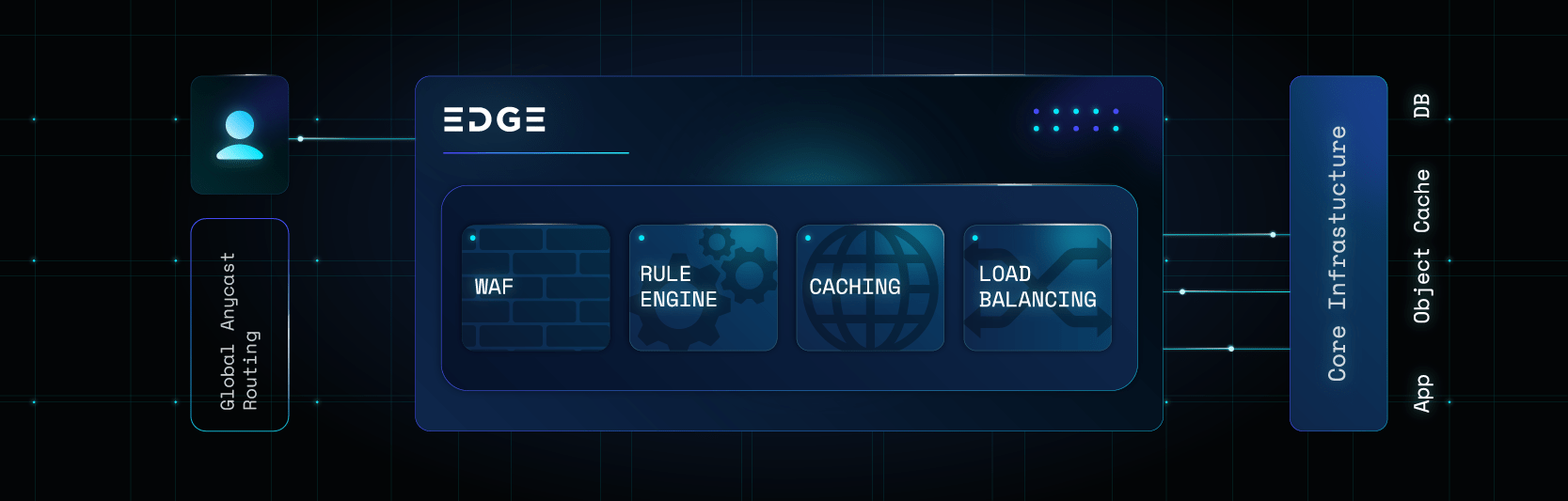
EDGE is not an add-on or a patchwork replacement. It is a new baseline for how WordPress operates at scale and the difference was visible from day one.
What changed under real production load
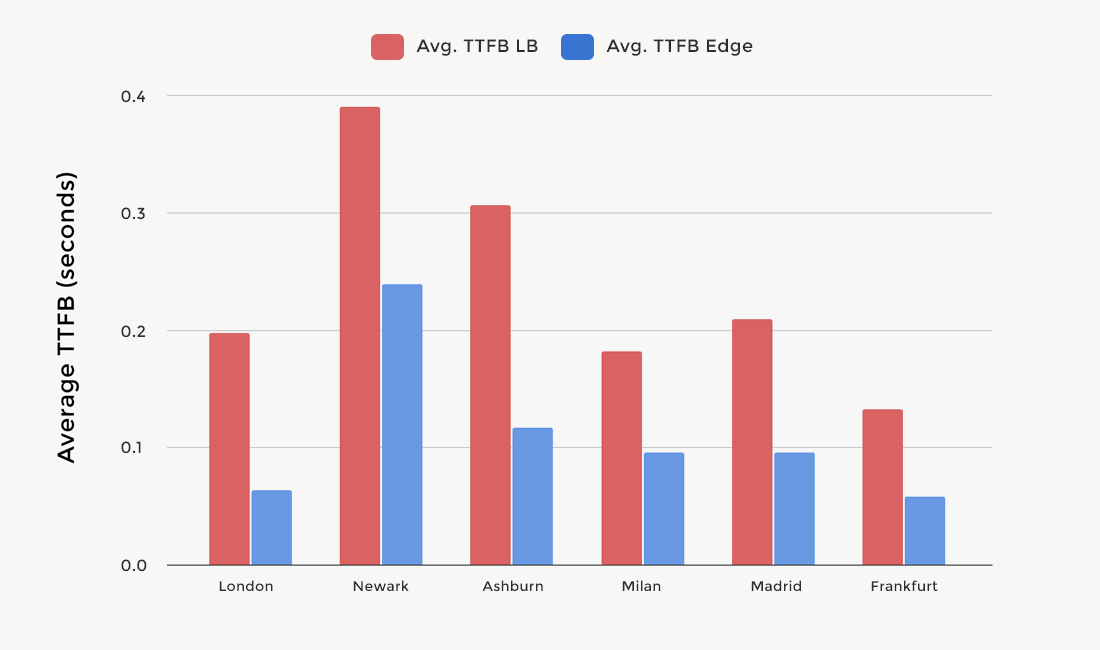
In high-traffic WooCommerce environments operating across multiple regions, moving request handling to the Edge reduced global Time-to-First-Byte by up to 4.7× and kept nearby regions consistently under 100ms.
During peak events, more than 100,000 malicious requests per minute were intercepted before reaching origin infrastructure.
Why EDGE works for WooCommerce in practice
This is how this architectural shift impacts performance, security and traffic in the context of WooCommerce.
Performance without per-site negotiation
Pressidium EDGE serves both static and dynamic responses from global edge locations when appropriate, reducing the number of transaction-related requests that must be processed by the origin server.

Because delivery decisions happen before application state is involved, cart and session behavior remain consistent under load.
That means:
✔ Faster cart and product page responses
✔ Lower origin load during campaigns
✔ Fewer performance exceptions to manage per store
WooCommerce remains responsible for business logic.
The edge layer ensures it isn’t burdened with avoidable delivery overhead.
Security before checkout friction appears
Malicious traffic, bot activity, and abusive request patterns are filtered at the edge perimeter before they reach login pages, checkout flows, or database queries.
Because harmful requests are intercepted earlier in the request path, they never compete with legitimate customers for PHP workers, database queries, or application resources.
The result is not just better protection, but smoother operation during peak traffic. Login pages remain accessible, checkout flows remain responsive, and legitimate users are not slowed down by automated abuse.
There is no per store rule tuning or constant firewall adjustments, and no reactive policy changes during campaigns or sales events.
Security shifts from reacting to problems at the origin to preventing them before they reach the application.
Traffic spikes absorbed early
Promotions, product launches, and seasonal peaks are when WooCommerce stores experience their highest concurrency. Under the traditional stack model, these are the moments that often trigger emergency adjustments: cache exclusions, firewall exceptions, or last minute performance tuning.
With an edge first architecture, traffic is handled earlier.

The Edge layer absorbs and smooths request volume through caching, bot filtering, and traffic control before requests reach the origin infrastructure. That way, it reduces the number of concurrent requests that WordPress and WooCommerce must process directly.
As a result, traffic surges do not immediately translate into origin pressure. Stores remain responsive during promotions and campaigns without emergency caching changes or reactive infrastructure adjustments.
Pressidium EDGE without migration
Since 2025, Pressidium EDGE has powered demanding production environments while giving customers greater peace of mind.
Until now, this edge-first architecture operated as a built in capability inside Pressidium’s managed WordPress platform, where delivery, protection, and origin infrastructure were tightly integrated by design.
Now it extends beyond that environment with EDGE Only. That same technology layer will soon be available as an independent service.
✔ No need to change your hosting provider.
✔ No infrastructure redesign.
✔ No disruption to existing workflows.
With EDGE Only, WooCommerce teams will be able to join the benefits of Pressidium EDGE without re-platforming, migrating, or modifying their WordPress setup.
➥ See EDGE Only in action
You can use the EDGE Mirroring Demo to observe how a WordPress or WooCommerce page responds when requests are handled at the edge perimeter.
The demo creates a read-only mirror of a page and serves it through the Edge layer, allowing you to examine response timing, caching behavior, and delivery paths without affecting production traffic.
➥ Get early access to EDGE Only
Before broader release, we are opening a limited early access phase for WooCommerce teams who want to evaluate Pressidium EDGE without changing their host.
Participation is limited to teams operating under real production load. This is not a beta for brochure sites. It is designed for stores that already operate under significant traffic.
Early access participants receive:
- Free usage during the early access period, regardless of traffic volume
- Exclusive benefits after launch
If your store operates under real production load, this is where the architectural shift becomes measurable. If you want to evaluate this shift in your own environment, you can request early access below.